4 Kasım 2012 Pazar

A Mummy in Her Backpack / Una momia en su mochila

To contact us Click HERE
 By James LunaSpanish Translator, Gabriela Baeza Ventura  

  • ISBN 9781558857568    
  • Published 30 Oct 2012    
  • Pages 64
  • Piñata Books/ Arte Público Press

A young girl discovers a shocking surprise in her backpack 
in this entertaining billingual tale for intermediate readers
Flor enjoyed her two-week trip to Mexico, though she’s glad to be back at school. But when she tries to pull her homework out of her backpack, she’s shocked to feel a cold hand clutching hers. Thinking that the pesky boys in her class are playing a trick on her, she turns around to look into her pack.

She’s even more stunned when she sees two yellow eyes peeking out at her.

Flor and her best friend Lupita stare in astonishment as a cowboy hat, followed by a small man with dark yellow skin and thin, stringy hair, emerges from her backpack. He introduces himself as Rafa, a mummy from the famous museum in Guanajuato. Flor visited the museum and learned that some people buried there mummified naturally. She can’t believe that an actual mummy hitched a ride with her to the United States!

Amusing hijinks ensue as the girls try to hide Rafa from their teacher, classmates and family. And when Rafa realizes that it’s almost the Day of the Dead, or El Día de los Muertos, he longs to return home. The girls are forced to reveal their secret and seek help from an adult. How can they get Rafa home in time for the annual celebration honoring deceased loved ones? Published in a bilingual “flip” format, young readers ages 8 to 12 will savor this entertaining story about mummies, friendship and responsibility.

Take a look at the book!

Crecimiento a golpe de ¡cadáver!

To contact us Click HERE


Las novelas de Guadalupe García McCall se destacan entre lostítulos para adolescentes latinos por su lirismo, calidad que inspira lalectura sin restarle importancia a las aventuras que expone.Su nueva novela, "The Summer of the Mariposas", seinspira en el clásico griego "La odisea" que ambienta con personajesmisteriosos del folclor mexicano.La historia gira en torno a cinco hermanas que se embarcanen una gran aventura al sur de la frontera.Siguiendo la estructura del viaje del héroe, las chicasencuentran todo tipo de obstáculos que deben superar y a su regreso habránobtenido el conocimiento necesario para afrontar los retos que dejaron en suhogar.Un año después que el padre abandona a la familia y deja deenviar dinero para el sustento de las niñas, la madre se ve forzada a trabajar,dejando a las hermanas libres para hacer con sus días lo que mejor les parezca.Las chicas, Odilia, Juanita, las gemelas Velia y Delia y lapequeña Pita, pasan los largos días de verano jugando Lotería y retozando en elrío Grande que corre cerca de su casa en Eagle Pass, Texas.Un día, mientras disfrutaban de las aguas refrescantes delrío, el cuerpo de un hombre aparece flotando cerca de las hermanas.Tras una mezcla de miedo, asco y curiosidad, Juanita -la másalta y fuerte de las hermanas y también la más decidida- se propone sacarlo delagua "como una amazona".Al quitarles las botas encuentran una bolsa plástica ceñidaal pie del cadáver.En ella aparece un rollo de billetes y un permiso deconducir vencido con su nombre y una dirección en El Sacrificio, justo al otrolado de la frontera.En lugar de entregarlo a las autoridades, a Juanita se leocurre que deben llevarlo a su pueblo para que la familia sepa de su paradero.El llamado de la aventura se intensifica al darse cuenta deque El Sacrificio queda cerca del lugar donde vive su abuela, a quien no hanvisto desde hace muchos años.Motivadas por la oportunidad de hacer algo diferente y sucompasión por la familia del difunto, en las chicas también opera su propiaexperiencia de abandono al no saber del paradero de su padre.Aunque al principio a Odilia no le agrada la idea, terminaaccediendo al ver que sus hermanas estaban determinadas a cruzar la frontera cono sin su ayuda.Las "cinco hermanitas" forjan entonces un pacto deunidad y se lanzan al azaroso viaje.Las hermanas conducen rumbo al sur en el cacharro que habíadejado su padre y desde el comienzo se encuentran con personajes reales ysobrenaturales que les retan su firmeza.Desde La Llorona hasta el chupacabras, las almas aladas delos guerreros aztecas y la deidad Tonantzin, figuran en el trayecto.El viaje les presenta un sinnúmero de retos que alargan latrama, quizás demasiado para el gusto de los lectores adultos, pero también laaventura para los lectores jóvenes a quienes está dirigida la novela.La narración incluye otras tradiciones culturales como laquinceañera y el juego de lotería, historias de origen azteca, aromas y saborestípicos de México, expandiendo así el panorama cultural en el que se desarrollala historia.La historia destaca también valores universales como lacompasión, la unidad y el perdón, ideales que teje en una trama desbordante deaventura e ingenio.

Boy Kings of Texas - Pig Behind the Bear - Desperado: Mile High Noir

To contact us Click HERE

The following is taken from the Tattered Cover Bookstore's newsletter, Shelf Awareness for Readers

The Dark Horse

First-time author Domingo Martinez is a finalist for the 2012 National Book Award for nonfiction, for The Boy Kings of Texas. He's the only non-Pulitzer Prize-winning finalist in that category, and Lyons Press is the only "small" publishing house in that category.

In a starred review, our reviewer said the memoir is "concerned with the deep distress of a border town [Brownsville, Tex.] kid unclear on his place in the world. Martinez's story is heartrending and uncomfortable, but he maintains a surprising sense of humor that keeps his reader cringing and rooting for him."

Martinez was surprised: "My phone started glowing around 6 a.m., and I happened to be awake. My first thought was, 'Wow; those bill collectors are starting much earlier nowadays,' and I ignored it because I didn't recognize the number, until it went off again about five minutes later and it was my agent, Alice.... I depend on her to translate most of what happens in this business because I'm so new at it, and I was registering some serious excitement, but I didn't know how to interpret it. I mean... it just wasn't computing that I was A FINALIST for THE NATIONAL BOOK AWARD. What's really funny is, when you read through that list, it's almost like the writers are putting question marks behind my name and book title, like 'Who the hell is this guy??' "

In a recent NPR interview, Martinez said, "If I stop to think about it, I might seize up. So instead, I'm reorganizing my Netflix queue.... The term 'dark horse' has been mentioned once or twice, and I have to chuckle. I wasn't even in the race two years ago. I wasn't even a horse, for that matter."

The National Book Award winners will be announced November 14 at a ceremony in New York. For the complete list of 20 finalists across four categories (fiction, nonfiction, poetry and young people's literature), visit nationalbook.org. --Marilyn Dahl, book review editor, Shelf Awareness


New Book: Pig Behind the Bear 

Pig Behind the BearMaria NietoFloricanto Press/Berkeley Press - October, 2012
[from the author's website]
Pig Behind The Bear – SynopsisIt’s 1971, one year after the killing of famed LA Times reporter, Rubén Salazar. A junior reporter, Alejandra Marisol, who works for the LA Times is asked to write a commemorative piece on Salazar in recognition of the one-year anniversary of his death. While doing work for the piece, Alejandra finds that she is embroiled in a murder mystery that appears to have ties to Rubén Salazar’s death. Alejandra uncovers a world of evil and corruption with the help of an unlikely collection of people who become heroes and who challenge us to think differently about ourselves and the world we live in; Rocky the philosophizing WWI veteran, Sumire the clairvoyant ex-Japanese internment camp prisoner, Tia (Aunt) Carmen, the wise-cracker who can wield a powerful left leg jab with a retractable prosthesis, Tony and Chucho, the neighborhood homeboys, and Gato the wonder cat. Alejandra also gets help from a dancing Jesus who feels misunderstood, and from his mom, Mary, who bestows Alejandra with a tube of lipstick that helps Alejandra unleash her inner strength. The reader will travel through streets and townships where rich Angelino culture comes to life, and where tragedy and despair are transformed into hope.

About the Author

Maria grew up in the Highland Park neighborhood of Los Angeles and moved from the area in 1984 to attend a Ph.D graduate program in Immunology at UC Berkeley. Maria currently resides in Oakland and works as a Professor of Biology at California State University, East Bay where she has been engaged in underrepresented minority student recruitment, teaching, and research for over 22 years. As a researcher and educator Maria’s writings have taken the form of scientific journal publications, and more recently popular press articles. Pig Behind The Bear represents Maria’s first work of fiction.

________________________

María Nieto’s Pig Behind The Bear is definitely a double treat: a fast-paced mystery story and a coming of age novel. At the center of both stories is Alejandra Marisol, a young L.A. Times journalist, who is as smart and courageous as she is charming and sensitive. While researching a story about the late L.A. Times reporter Rubén Salazar in 1971, she stumbles across a number of ritualistic murders and other crimes against the most vulnerable among us: the children and the immigrants. Her outrage fuels her determination to bring to justice the criminals. María Nieto has penned a most intriguing crime story, featuring a young heroine but also plenty of engaging characters of all ages—and yes, with plenty of romances for all ages, too! Pig Behind The Bear is sure to capture the attention of both younger and older readers, who will keep turning the pages as fast as they can till the thrilling and satisfying end! Brava, María! Encore: otra, otra!

Review by Lucha Corpi, author of Eulogy for a Brown Angel: a Gloria Damasco Mystery.


Desperado: A Mile High Noir
I've been working with the staff of Arte Público Press on my next novel (and first book-length crime fiction in a few years). I've even been privileged to review suggested cover art - I think the cover will be a knockout. La Bloga readers will see it first when it's ready.

The book is entitled Desperado: A Mile High Noir, and it features Gus Corral, a character from my short story The Skull of Pancho Villa that appeared in the anthology Hit List: The Best of Latino Mystery (Arte Público Press, 2009.) Gus tangles with cartel thugs, con men and women, stolen religious icons, over-exuberant federal agents and Denver cops, and dangerous pals from his youth, all played out against the tensions surrounding the economic and social changes to his neighborhood in Denver's North Side, also known as Highlands. It's great to be back on the gritty Denver streets.

The book is set for a Spring, 2013 publication date.


Later.

Advice for debut-book authors

To contact us Click HERE

by RudyG
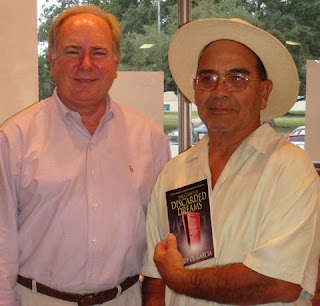
River Oaks Bookstore's Michael Jones & author
I've completed the initial segment promoting my first book,The Closet of Discarded Dreams, in Denver, Nuevo Mexico, L.A. and San Anto& Houston, Texas. While I'm still digesting events in N.M. and Texas, Ithought it might be useful to summarize some of the most important things Ilearned in that they might help others succeed with the whirlwind experience thatmany aspire to. In no particular order, here are my preliminary points:
Fine tune your book tour schedule to your abilities andcapacity for stress. Mine was a whirlwind, not only rushing past me like a opening Xmas presents as a kid, but with toolittle time between events, too much driving that wore out my coccyx and jet lag that often reminded me of my age. It should havestretched over months rather than weeks. Once yours begins, the rollercoastermakes no stops for huevones.
Rely on published authors you know. Don't be shy; ask them everything. Askthem what surprised them most. See if they'll share their contacts, Emaillists, connections, data bases and then be surprised when your familia andclosest friends bring wine, cheese and biscochitos to a read.
Prepare everything well in advance. Idevoted two solid months before my publication date (40 hrs./wk.) tosetting up artwork, printing and shipment of books, bookmarks, business cards,posters, flyers and coasters; making connections for venues; contact media forpublicity ops like interviews and reviews. Then a two-by-four came out of The Closet and struck me because I didn't begin early enough and/orI should have left additional lead-time before the first appearance.
Your largest audience for your firstreading/signing of your novel, collection or poetry book may be your hometownor wherever you're best known. (Unless you burned too many bridges, in which case you go for the out-of-towners.) Do everything to make it the best showingpossible. Even though over fifty people attended mine, I later realized how many corners of my little corner I'd not reached.
Some of author's best supporters - la familia
Overestimate and anticipate your need for books and bookmarks,at least. One day I had sixty copies of my book. Ten days later pendejo-Me had to tellthree audiences that there were none available there at the event. I did fineon bookmarks, but ran out of business cards. Another place I lagged was onsolidifying publisher orders by those hosting me. Entropy and disappointmentsomehow seem to converge like white lies with getting busted. Improved handling of thetwo sources for books would have covered my nalgas in all cases.
Develop and constantly update your database ofcontacts, events, meetings, etc. I started out well two months before publication,but the constant stream of E-mails, meetings and phone discussions didn'talways get entered. The bill for this will come due, I know.
Keep a detailed log of what happens tocopies of your book. Beyond who you billed and who still owes, the flood ofbook exchanges with other authors, books promised for reviewers or others willsoon overwhelm you if your memory is like mine, which is casi ausente. Some of this is relevant fortax purposes but more importantly, all of it is necessary for the success ofyour first book and the future of your second.
Take no one for granted. Obviously you need to remember who topublically thank for their help on your tour. But also, don't assume thatanyone you interact with is less intelligent or capable as you. I did this acouple of times and set myself up to be big-idiota-center-stage when I shouldhave been most alert and prepared. I believe these were cases of the dreadedmuy-muy syndrome attempting to take root in my ego.
Go for a more perfect reading. Periodicallylook up at some length at gente at your readings, not just peeking to see if they're still awake; the one whose your age often won't be. I read once withfive other authors, including experienced ones, and I was the ONLY person to dothis; the others NEVER looked up once. This requires prepping your readings,reading them aloud many times by yourself or with a critic, using typed copyrather than your book (or at least within a copy of your book), marking up yourcopy for pauses, word emphasis, intelligent enunciation (like I had problemsreading "of value" and had to pause after "of") and atleast for me, using fourteen point type. One day it'll be sixteen. I also learned that I didn't need torote memorize my text; that came from repeated reading.
Do your best, especially for small audiences. Experienced, even well-known, authorswith publisher support that included airfare, hotel, big bookstore liaison inlarge cities advised me they had had audiences of 3 people. When only two or threeshowed at a couple of mine, I was ready to give them the greatest performance Icould.
Tweet, friend, share, post and make it a joy to read. Iwon't nominate myself as the best at this (consider this post), butmy wisest daughter Marika has impressed upon me the importance of keeping mi cara infront of my fans by sharing news every few days. And at least tryingto make it fun, funny, informative, interesting to read.
Give of yourself to your audience. I'm guessing that themajority of an audience comes to hear you, not your text. Yes, they want tofind value in your book and your words may be great. But they want to knowyou, be a part of the special thing that's fallen on you the author. Don't givethem dry facts about you, your life, your road to authorship. Give them the funny,the thrilling, the emotion behind writing that book. If you have to, invent some. But relax because they wantthe real you. Take pride, yes, because they expect for you to convince they shouldbuy/read the work. Then fulfill your responsibility to make them glad they cameand they'll look forward to book two.
Author Garcia finally takes a break
Take breaks to give yourself a qué-suave! You got a bookpublished! Enjoy the moments. Remind yourself of the major hurdle you justleapt. Have some beers, some agavero, some President (not in that order) with family, friends and colleagues. And laugh, with joy.Then get to writing whatever you have the most energy and ganas for, because you're meant to be a writer, not some puto self-promoter.
Undoubtedly I've forgotten or not emphasized things that shouldbe. Any one of these items could be expanded. This is also just one author'sexperience. I welcome additions, corrections, elaborations and contributionsfrom others who know more. Or less.
Adelante con otra obra! 
RudyG, aka Rudy Ch. Garcia, author of The Closet of Discarded Dreams, taking a break before visitingnorthern and southern Colorado to share my work. Sometime soon after I catch my breath and get some more pinche books.

From Los Angeles to The Great Plains-- Latest News: "Your Power, Your Decision: VOTE"

To contact us Click HERE


by Amelia Montes (ameliamontes.com)

Last week Iwrote about poet and fiction writer, Xánath Caraza, a transnational U.S. Midwest IndigenaMexicana.  
Xánath Caraza
There is more to saythis week about Xánath—especially if you are in Los Angeles! On Saturday,November 10 (yes--in Los Angeles) you have the opportunity to learn fromXánath.  She will be giving apoetry workshop from 12:30-3:30p.m. at Tia Chucha’s Centro Cultural bookstore.  Here is her description of the workshop: 
Taller de poesíaen español con Xánath CarazaEn este tallerde poesía examinaremos y discutiremos trabajos seleccionados de Sor Juana Inésde la Cruz, Macuilxochitzin y Yanga. Escribiremos nuestros propios poemas y finalizaremos la session con unalectura informal de poesía donde compartiremos lo que hayamos creado.

Poetry Workshopin Spanish with Xánath CarazaIn this poetryworkshop, we will examine and discuss selected works of Sor Juana Inés de laCruz, Macuilxochitzin, and Yanga. We will write our own poems and we will end the session with an informalpoetry reading where we will share what we have created. 
After the poetryworkshop, take a break, a tomar un cafecito—and then come back to Tia  Chucha’s Centro Cultural bookstore at5:00p.m. to hear Xánath read from CONJURO.
What a great wayto spend next Saturday at Tia Chucha’s. 
When:  Saturday, November 10, 2012What:  Writing Workshop led by Xánath CarazaWhere:  Tia Chuca's Centro Cultural BookstoreTime:  12:30-3:30p.m.
What:  Xánath Caraza reading from her book, ConjuroWhen: (same day)Time:  5p.m.Where:  Tia Chuca's Centro Cultural Bookstore
This past week,Xánath was at The Writer’s Place in Kansas City, Missouri (where Xánathlives).  It was a Dia de losMuertos celebration and reading. One of Xánath’s poems, “Luz de Octubre,” became art on the wall (seebelow).  Orale Xánath.
"Luz de Octubre"


********************************************************
Switching now toLincoln, Nebraska where the National Association for the Advancement of Colored People (NAACP) Lincoln chapter had its annual banquet yesterday (Saturday,November 3rd) and the theme was “Your Power, Your Decision--Vote.”  
Lakota Tribe member, Myron Longsoldiergave the Invocation. Frank LaMere, from the Winnebago Tribe, gave thekeynote.  LaMere is a human rightsactivist who has had extensive involvement with empowerment efforts of nativepeople throughout the United States. He was named Peacemaker of the Year by the Nebraskans for Peaceorganization for his work to end the sale of alcohol in Whiteclay.  He chaired the Native American Caucusat the 2000 and 2004 Democratic Conventions. In 2008, the documentary, “The Battle for Whiteclay” followed LaMere, Russell Means, and Duane Martin Sr. intheir efforts to curtail alcohol consumption on the Pine RidgeReservation.  If you haven’t seen“The Battle for Whiteclay" I encourage you to see it! And since it is still near the time of Diade los Muertos—see it in honor of Russell Means who recently passed away onOctober 22nd. 
Last night FrankLaMere spoke with emotion and directed his comments to all of us:  “Indian, Brown, Black, White”—that itis important to see the devastation happening at Pine Ridge as a problem thataffects every one of us.  In anopinion piece for the New York Times, LaMere wrote:  “Any action short of shutting down Whiteclay and cripplingthe enterprise that peddles alcohol among the Lakota people is unacceptable.  The death toll exacted on the Lakotapeople by Anheuser-Busch and its partners continues to rise . . .Lakota children are orphaned and struggle through life with the effects offetal alcohol syndrome.” 
Frank LaMere in "The Battle for White Clay"
In the book, Daysof Destruction, Days of Revolt by Chris Hedges and Joe Sacco (published this past June), they write:  “Whiteclay is an extension of the longnight of ethnic cleansing, degradation, and murder stretching back more than acentury and a half, to the U.S. Cavalry charges on Indian encampments, wherescreaming women and children were shot down as they fled, and the systematiceradication of food sources by the white colonizers, who soon reduced bands ofragged Indians to destitution.  Fights,brawls, and shootings eventually shut down the bars and saloons ofWhiteclay.  All sales are nowcarryout.  But Whiteclay stillprovides the liquid fuel for car wrecks, diabetes, heart attacks, domestic abuse,divorces, joblessness, violence, early deaths, and suicides: one in five Indiangirls and one in eight boys attempts suicide by the end of high school.  The averale male life expectancy onPine Ridge is forty-eight, the lowest in the Western Hemisphere outside ofHaiti” (4). 
Frank LaMere giving the keynote at the NAACP Banquet
LaMere’spowerful words at the NAACP in Lincoln, Nebraska last night prompted me towrite you about it, dear La Bloga reader, especially as we near election daythis coming Tuesday.  “Your Power,Your Decision:  VOTE” was the timelytheme.  There is much at stake—andyou are a part of the circle just as much as I am and Frank LaMere is.Participate!  VOTE!

13 Ekim 2012 Cumartesi

Review: The Neruda Case ... and More Bits and Pieces

To contact us Click HERE


Review
The Neruda CaseRoberto Ampuero,translated by Carolina De RobertisRiverheadBooks (2012)

Rolando Hinojosa once told me that writers should write books, not book reviews. Ieventually understood what he meant (at least, what I think he meant) and I cutback on reviews for La Bloga and other outlets. However, every once in a whileI come across a book that spurs me to write a few words of praise, despiteRolando’s wise lesson, because the book is special in some way, or several ways.
TheNeruda Case by Roberto Ampuero is one such book.
TheNeruda Case is the first of Ampuero’s books to be translated into English,although he has long been published worldwide. He is a professor at the University of Iowaand has lived in the U.S.for years. His reluctant detective, Cayetano Brulé, is the protagonist in aseries of novels that are immensely popular. Brulé is a Cuban living in Chile. Ampuerois a Chilean who has spent time in several of the countries that serve asbackdrops to his stories including Cuba,East Germany, Bolivia, and Mexico, all featured settings inThe Neruda Case.
Roberto Ampuero
The bookliterally spans the globe and decades of time. It begins in 2006 when Bruléfixates on a photograph of Pablo Neruda, which in turn launches him intoremembrances of his first case. The reader then steps into the turbulent Chileancrisis of 1973. Allende’s government is on the verge of a violent collapse. Thepoet is on the verge of dying. But he has one last project to fulfill and heengages the young Brulé to carry it out.
Brulélives with his activist wife in Valparaíso, although the marriage is on therocks. He encounters the celebrated poet Neruda at a party, and eventually thetwo meet privately to discuss Neruda’s quest. He wants Brulé to find DoctorBracamonte, whom Neruda had known thirty years earlier in Mexico City. Brulé assumes the doctor may bea last hope for the poet, who is suffering from prostate cancer. He doesn’trealize, of course, that he has not been told the entire story and that he isabout to embark on an adventure that will throw him into the midst of the ColdWar and the international tensions that existed when capitalismand socialism competed for hegemony in Europe, Latin American and Asia. And only later, as he tracks down clues around the world, does he understandthat his search is for something much more precious and personal to Neruda thanthe doctor’s expertise.
Salvador Allende and Pablo Neruda
But thebook is not a political diatribe. Far from it. This is a fast-moving thrillerwith a sprawling tableau, satisfying doses of suspense, and three-dimensionalcharacters. Famous and infamous historical figures dot the literary landscapeincluding Salvador Allende, who appears in a wonderful scene with Neruda that dramatizesthe last time the two men saw each other. Brulé’s odyssey brings him in contactwith several of Neruda’s mistresses, writers, poets and artists of theculturally fertile seventies, Che Guevara’s girlfriend, cold-blooded Stasiagents from East Germany,the jazz musician Paquito D’Rivera, and even the play Life of Galileo byBertolt Brecht has a role in the plot.
Georges Simenon
That playis a signal for one of Ampuero’s themes. Brecht’s drama centers on Galileo’storment when he sacrificed his scientific and philosophical views in order to survive persecution. In a sense, Galileocreated another version of himself. At one point in the book Neruda commentshow he has re-manufactured himself several times, played several differentparts over the course of his life, and it is almost too obvious when Neruda tellsBrulé that he should create another persona for himself, that of a detective.Neruda, the poet, the artist-creator, instructs Brulé to use the mysteryfiction of the great Georges Simenon as detective training manuals. Neruda believes that Simenon's illustrious detective, Maigret, can transform the young Brulé into the investigator that Neruda needs at that particular time of his life. In thisway, fiction and reality intermingle, art and life compensate one another, andthe reader is faced with a multi-layered mystery that satisfies on all levels.
One ofthe main aspects of the book is Ampuero’s fictional glimpse into thecomplicated, contradictory, and very human character of Pablo Neruda. The fivechapters are named after women who played key roles in the poet’s life. Neruda’swomanizing and, frankly, scandalous treatment of his wives and mistresses areessential to the story the author writes. But so, too, are the poet’s artistic accomplishments,his iconic role in Chilean history, and his impact on all those who came intocontact with him. 

Ampuero admitted to an interviewer that Neruda made apowerful impression on him when he was a child and lived in the sameneighborhood as the poet. He went on to say:
“I wrotemy novel about Neruda, staying true to the actual history of Chile between1970 and 1973, because I admire him as a poet, because I was curious about himas a neighbor, and because his personal life intersected with crucial momentsof 20th-century history.
“But I had another, powerfulreason for writing my novel. Sheltered by the license of fiction, I strove toportray the Neruda of flesh and blood, the real human being with his grandeurand meanness, loyalties and betrayals, certainties and doubts—the poet whocould love passionately and at the same time leave everything to embark on anew affair, a more feverish and impassioned one, that would allow him to writebetter poetry. Neruda was a towering poet, a sharp politician, a human beingwho searched tirelessly for love, and a man who enjoyed the pleasures ofbourgeois life. He contradicted himself. It isn’t easy to write a novel thatcaptures the real human being, as Neruda’s fame is so solid and universal thatwritten works about him tend toward the apologetic and adulatory, keeping himon a pedestal. I believe that both his genius as an artist and his authenticside as a man spring from his complex spirit, his light and shadow, and thepassion of his human condition.”

You can read the entireinterview here.

Thequibbles I have with the book relate to a few glitches that probably need to beexplained by the translator. Overall, the prose is excellent and one of theauthor’s main talents is that he never intrudes into the story that is actedout by his characters. But some sentences are awkward and seem out of place.Certain passages appear to be repeated, or at least the narrative thrust ofthese passages show up more than once. But, these are minor.  I recommend The Neruda Case and eagerly anticipatemore from Roberto Ampuero. 


Bits and Pieces BRACERO PROGRAM -- HISTORIC GUEST LABOR PROGRAM BETWEEN U.S. AND MEXICO FEATURED IN SMITHSONIAN EXHIBIT AT REGIS UNIVERSITY  [from Regis University website]In addition to viewing one of the most interesting and relevant exhibits about the labor guest worker programs between the United States and Mexico, the orchestrator behind Regis University’s two-month hosting of the historic Smithsonian exhibit Bracero Program wants visitors to the exhibit to gain an understanding of the human face behind the Bracero Program.
Regis University, Colorado’s only Jesuit Catholic university, is hosting the Smithsonian Institution’s travelling exhibit called Bittersweet Harvest: The Bracero Program, 1942-1964, through Oct. 28 in the University’s Dayton Memorial Library.

“The Bracero exhibit is intriguing because of the individual stories that comprise it,” said Nicki Gonzales, assistant professor of history at Regis University and the individual orchestrating the exhibit at the University’s North Denver (Lowell) campus “I want people to recognize that each laborer had a story that was just as rich and just as important as the observer’s. I would like those who view the exhibit to come away with a more complete picture of our nation’s history and an appreciation for the contributions that Mexicans have made. The Bracero history is a transnational story, as is much of our history.”

Begun in 1942 as a temporary war measure to address labor needs in agriculture and the railroads, the Bracero Program eventually become the largest guest worker program in U.S. history. Small farmers, large growers, and farm associations in California, Arizona, New Mexico, Texas, Arkansas, and 23 other states hired Mexican Braceros to provide manpower during peak harvest and cultivation times. By the time the program was canceled in 1964, an estimated 4.6 million contracts had been awarded. 

Bittersweet Harvest, a new bilingual exhibition organized by the Smithsonian’s National Museum of American History and circulated by SITES, examines the experiences of Bracero workers and their families, providing rich insight into Mexican American history and historical background to today’s debates on guest worker programs.

Consisting of 15 freestanding, illustrated banners, the exhibition combines recent scholarship, photographs from the Smithsonian’s collection, and audio excerpts from oral histories contributed by former contract workers.

Gonzales’s extensive background in history is evident as she discusses in almost reverent tones the individual stories that comprise the Bracero exhibit and the many questions raised by the exhibit.

“On one hand, you have the US desperate for labor during and after WWII, and on the other, you have a group of men who make the decision to leave their homes and families in Mexico for opportunity in the US,” Gonzales explained. “The individual stories behind that decision are fascinating...what were their lives like prior to leaving, what did they give up in making the decision to leave, what were their experiences like in the US--with all of the challenges that brought: racism, classism, exploitation, broken promises...yet, they were able to create a culture, to survive, and to send money home....all meanwhile aiding the American economic machine, contributing in vital ways to our country's victory in WWII...until the mid-1960s, when America would pass a landmark immigration law, partly in response to the results of the Bracero program. And, finally, the question of what effects did their decision to leave Mexico as a Bracero have on the rest of their lives...and the lives of their children and grandchildren?”

In addition to the exhibit, Regis University will sponsoring numerous additional activities in conjunction with the exhibit. Among those are a Bracero Program Oral History Project, a Romero Troupe Theater performance and actor talk-back, and a labor history panel featuring four professors and activists.

The Bracero Program Oral History Project
includes students and faculty who are gathering oral histories from former Braceros and their family members. These interviews, as well as any artifacts will be exhibited near the Smithsonian exhibit. These video interviews will be stored in the archives of Regis University's Center for the Study of War Experience, a nationally-recognized archive of oral histories and artifacts related to war-time experiences. 


The Romero Theater Troupe will perform a short play on the history of the Bracero program through the Bracero laborers' experiences. A panel of speakers will follow the performance. The labor history academic panel is expected to feature experts presenting their work on the Bracero Program and related topics. Several additional supporting events will be conducted during the next two months in conjunction with the exhibit at Regis University.

For more information, on the exhibit or to participate in one of the projects, contact Gonzales at ngonzale@regis.edu or Sonia Del Real at sdelreal@regis.edu.


James Luna Presents Making Do: Performance and Installation Premiere

Wednesday, October 3 or Friday, October 5 7:00 p.m.

Performance artist James Luna premieres his unique art installation and performance piece, Making Do, created specifically for a limited engagement at the Denver Museum of Nature & Science.

This special premiere includes a performance by Luna, a chance to view the installation, and an artist’s reception.

In Making Do, Luna explores a “survival skill” developed by his California Indian peoples to endure in a post-contact world. Luna conveys how Indians cleverly “made do” in hopes of maintaining an Indian life while coming to grips with the loss of the “free” lifestyle they once lived.

Luna, a Pooyukitchchum/Ipai native, is a world-renowned performer and artist who has produced a variety of artworks illustrating his artistic, social, and political commentary.


$15/member, $18/nonmember
Ricketson AuditoriumCash bar reception to follow.

Reservations are required as space is limited. Call 303.370.6000 (M-F, 9-5) or click here to purchase tickets online.


Scholastic Art & Writing Awards


 State Out of the Union at the Tattered Cover
State Out of the Union: Arizona and the Final Showdown Over the American Dream  Jeff Biggers

Oct 11 2012 7:30 pm Colfax Avenue

[from The Tattered Cover website]

Days after President Obama beseeched his fellow lawmakers in the State of the Union ‘to come together as a people, Republicans, Democrats, Independents,” and “find common ground, even as we're having some very vigorous debates,” the extraordinary effect of Arizona’s sagebrush rebellion had already rippled across the country.

In the alarming and fascinating State Out of The Union, award-winning author Jeff Biggers shows how the Arizonification of America is in full swing. More than 25 state legislatures have already introduced copycat anti-immigration bills of Arizona’s controversial SB 1070. But immigration reform is just the opening salvo—in Arizona, and for the 2012 elections.

With one of the most radical Tea Party factions in control of its legislature, Arizona and its growing bevy of wingnut politicians have not only dislodged Sarah Palin as one of the most popular jokes on late night TV shows, but have set in motion one of the most alarming challenges to federal authority in history. The legislature has passed several bills challenging federal authority on gun laws, Medicaid, and the rights of undocumented children to attend school or go to the emergency room. One bill debated in the state congress proposed prohibiting "courts from considering international law or legal percepts of other nations or cultures when making judicial decisions." Another bill required federal environmental inspectors to register with the sheriff whenever its representatives enter one of Arizona's fifteen counties. One Forbes reporter wrote that the bill could be summed up in three words: ”Stay outta Arizona.” As a precursor to the 2012 election, Arizona defiantly unveiled its vision of a Tea Party America—that may be our future.

About the Author


Jeff Biggers is the American Book Award-winning of The United States of Appalachia, and In the Sierra Madre. He has worked as a writer, radio correspondent and educator across the United States, Europe, India and Mexico. His award-winning stories have appeared on National Public Radio, Public Radio International and in numerous magazines and newspapers, including The Washington Post, The Nation, The Atlantic Monthly, Salon, among others. He splits his time between Tucson and Illinois. His website is: www.jeffbiggers.com

Pueblo Chile and Frijoles Festival Saturday, September 22, 2012 - 10:00am - Sunday, September 23, 2012 - 4:00pmThis annual event set up by the Greater Pueblo Chamber of Commerce features entertainment tents, vendors, and of course, roasting chiles and produce for sale. Cost: $2 entry fee for festival. During the Festival the museum will have the popular Pony Rides along with free admission to the trading post featuring living history presentations and the Native Thundering Voices Community featuring singing, dancing and drumming. The Pueblo Herb Society, Pride City Quilt Guild and Pueblo Handweavers Guild will also demonstrate their crafts. The museum’s galleries will be open with admission at just $1 per person. For more information: 719.583.0453.
El Pueblo History Museum Information
301 North Union
Pueblo, CO 81003


Later.

Staggering down las calles de Denver's Northside

To contact us Click HERE

by Rudy Ch. Garcia
Three Chicanos who live and practice their arts in Denver: aretired factory worker, now artist and music aficionado; a former practicinglawyer turned novelist; a formerly employed bilingual teacher who sculpts hisgardens and fiction.
Thursday night we walked the blocks of what natives call theNorthside. The gentry, developers and transplants have taken out much of itsculture, much as they take out weeds from their yards and the characteristicarchitecture of the neighborhood homes to replace them with foo-foo plants andminimalist houses. So, we walk the blocks, commenting on our loss and deridingthe substitutions.
The second floor apartments on 32nd & Zuni where mexicanofamilies once could afford to live and send their niños to neighborhood schoolsto learn to read and write in their native language are now hundred thou condoswhere Spanish is much less heard, if at all. The former residents relocated tooutlying areas where rent is cheaper and instruction their kids receive now allin English.
The flat-roofed buildings that once housed bars where one ofour fathers and a father-in-laws drank themselves into alcoholism and exchangedstories of cómo era when they grew up in the San Luis Valley or crossed overlooking for more than just cantinas with cold beer and pool tables.
The old tequila bar that served the best chorizo con huevosbreakfast and where you could order obscure tequilas for less than half theprice of the yuppie establishments that sit there now with no Spanish speakersto speak of and food prices that make you wish you weren't hungry. The formerbar owned by relatives of a Jalisco distillery family who succumbed to a lavishpurchase offer that ousted one of the best places to compose fiction on aSaturday morning.
The Anglos passing by us, wondering quien sabe qué about us,some not daring to look up from the dog they're walking nor respond to a hello,no matter that the only difference between the three of us and gringo drunkswho'll later pepper the sidewalks are our physical features.
A plethora of restaurants/bars overloaded with customerswith too much discretionary funds, too much searching for identity and culturein an area they helped strip of the same.
Multi-stored structures marring the skies with the barenessof concrete and glass where once stood brick homes with families, children whowere sent to public, not charter or private schools, where the music ofquinceañeras and birthdays formerly rang out on weekends, and now thousanddollar bikes and BMWs mutely sit on patios or out front.
The old, Chicano bar-Italian restaurant still open. Stillserving cheap drinks and its neo juke box blaring oldies. A kitchen fire andfire alarm end a brief stay.
We walk the sidewalks, the three of us. Admitting somebenefits of progress, though much of that is limited to one day being in aposition to sell our houses for much more than we paid and then being in theposition of leaving what once was.
We talk of places and times and remember-whens; we drinkmore, but not enough. Celebrating recent individual accomplishments; wishingeach other well and future luck. We can't do the same for the old DenverNorthside. The name itself has been taken from us, regurgitated as a string of truncatedlabels more descriptive of the money entering the area, the overpopulation ofdrinking places, the higher income levels of the encroaching gentry.
We had a good time anyway. Because we know more andnotsimply about the history  of thisarea. We experienced things here that stay with us, in our artwork and literaryworks. We still feel it. Live it. Lamenting the changes doesn't change that.
Es todo, hoyRudyG